
sports therapy BLOG
Written by Georgina AKA 'Miss-Fix-It'
The Lower Back Pain Fix
Today you're going to learn EXACTLY what you should do if you're struggling with lower back pain (LBP)...
But don't worry; this isn't an opinion piece! This article if fully referenced for all you science geeks out there
However; before we get into LBP solutions we're going to start off by answering an age old question...
WHAT CAUSES LOWER BACK PAIN ANYWAY?
lower back pain: A global epidemic
The impact of LBP can be compared to conditions like Heart Disease and Diabetes when you consider the financial impact it has on our Health Care System (Ardakani et al. 2020).
However; even though it's occurrence is common, the cause isn't as simple to diagnose as you may think, reason being:
THE LOWER SPINE OR 'LUMBAR' IS MADE UP OF:
5 Vertebrae
6 Bones
7 Ligaments
10 Sets of Nerves
10's of Muscles
Which as you've probably figured out; means it’s complex!
But regardless of the complexity, there's still an array of simple things you can do to alleviate pain (Gleinert-Rożeket al. 2020).
lbp ISN'T 'JUST all IN YOUR HEAD'
SYMPTOMS OF PAIN ARE CREATED VIA A MULTITUDE OF DIFFERENT PATHWAYS...
Whether it be physical in nature (caused by inflammation) or even aggravated through mentally driven fear avoidance.
Unfortunately, most people try to resolve LBP by treating the symptoms, which can reduce discomfort...
But it'll more likely lead to cyclic back pain which reoccurs every few months or years.
WHAT WE REALLY NEED TO DO IS; DETERMINE WHAT'S REALLY CAUSING PAIN, OR AS IT'S KNOW IN THE PHYSICAL THERAPY WORLD - THE 'PAIN GENERATOR'...
Catchy I know!..
But as catchy as it maybe the uncomfortable truth is that many practitioners fail to identify 'the pain generator' during a consultation...
Which again can lead to treating the
symptoms of pain, rather than what's causing pain in the first place.
COMMON CAUSES OR CONTRIBUTORS TOWARDS LOWER BACK, PELVIC AND BUTTOCK PAIN INCLUDE:
Disc herniation
Facet joint locking
Nerve root irritation
Leg length discrepancy
Sacroiliac joint dysfunction
Posterior/Anterior pelvic tilt
(Borenstein and Calin 2012).
LBP affects 10-30% of the world’s population, with;
80% OF PEOPLE STATING THEY HAVE BEEN AFFECTED BY LOWER BACK PAIN AT SOME POINT IN THEIR LIFE. WHICH MAKES LOWER BACK PAIN THE MOST DEBILITATING INJURY GLOBALLY (Ardakani et al).
lower back pain: A SCIENTIFIC solution
Due to the large prevalence of LBP amongst the
working population we need to find a way
to help to fix the problem, especially when you consider the effect it's having on our health care system.
So what's the best solution? Well;
WE'VE ALREADY IDENTIFIED THAT DISCOVERING THE CAUSE OF YOUR SYMPTOMS IS THE MOST VITAL ASPECT OF RECOVERY
But what's next? And how do we stop it from returning at all?
A PAIN MANAGEMENT PROGRAMME - THAT'S WHAT!
Goldman and Jones (2011) state that:
MANUAL THERAPIES SUCH AS; SOFT TISSUE THERAPY AND MANIPULATION REDUCE MUSCULAR STRAINS FROM REOCCURRING IN THE FUTURE
Which is supported by Hidalgo et al. (2013) who also found that:
SOFT TISSUE TECHNIQUES, SPINAL MANIPULATIONS AND MOBILISATIONS HELP TO SIGNIFICANTLY REDUCE SHORT AND LONG TERM BACK PAIN
However, these successful results only occurred:
WHEN TWINNED WITH A PERSONALISED EXERCISE PROGRAMME
According to Smith and Grimmer-Sommers (2012), one of the most effective ways
at reducing LBP for the long term (6 months +) is by adhering to a
personalised exercise programme.
Reason being; partaking in an exercise regime designed around your diagnosis (or areas that need improvement) not only reduces pain scores but significantly reduced injury recurrence too (Grimmer-Sommers 2012).
This evidence is backed up by Brummit et al. (2013) who found that exercise intervention is not only good for the long term but also reduced pain scores in the short term and helped improve the level of disability for the participants.
Paley and Johnson (2016) also investigated how exercise reduces our perception of pain. They found an improvement of people’s reports of pain once exercise regimes were followed, and also saw a significant improvement to mental health.
The same study included how:
A PAIN MANAGEMENT PROGRAMME (IN THE FORM OF EXERCISE PRESCRIPTION) FOR LOWER BACK PAIN HELPED TO REDUCE SWELLING AND INFLAMMATION...
Which further strengthened the findings that specific exercises reduces pain (Paley and Johnson 2016).
Paolucci et al. (2018) also confirms these findings by saying that:
MODERATE EXERCISE HELPS TO REDUCE INFLAMMATION WITHIN YOUR BODY AS WELL AS ENHANCING MENTAL HEALTH...
What more could you ask for?!
lower back pain: TLDR
So there you have it, everything you need to know about LBP, Establishing that:
EXERCISE REGIMES THAT ARE SPECIFIC TO YOUR PAIN GENERATOR CAN HELP ALLEVIATE YOUR SYMPTOMS AND REDUCE THE CAUSE FROM REOCCURRING! ESPECIALLY WHEN COMBINED WITH SOFT TISSUE TREATMENTS AND/OR MANIPULATIONS.
So now that you're more aware of the pressure on our National Health System, here's what you can do to help yourself:
Identify triggers
Before you seek out help try to identify the circumstances that cause you problems first
Get informed
Once you know what causes the problem, then find a practitioner with the right solution
Find THE practitioner
Stop wasting your GP's valuable time and seek out an Osteopath, or Physical Therapist who can really help
Establish THE plan
The RIGHT practitioner will determine a prevention and/or maintenance plan (Ardakani et al. 2020)
Do what you're told
Once you have a solution, don't forget to do your homework...or you'll end up back at square one
References:
Ardakani, E.M., Lebouef-Tde, C., and Walker, B.F.. (2020).
The prognostic merit of self-reported triggers of recurrent low back pain: study protocol. Chiropractic & Manual Therapies volume . 28
(1.) https://link.springer.com/article/10.1186/s12998-019-0291-6
Beynnon, B.D. Uh, B.S. Johnson, R.J. Abate,
J.A. Nichols, C.E. Fleming, B.C. Poole, A.R. Roos, H. (2005).
Rehabilitation after Anterior Cruciate Ligament Reconstruction: A Prospective, Randomized, Double-Blind Comparison of Programs Administered over 2 Different Time Intervals. The American Journal of Sports Medicine. 33 (3), 347-359.
(2.) https://journals.sagepub.com/doi/10.1177/0363546504268406
Borenstein, D.G. and Calin, A (2012). Fast
Facts: Low Back Pain. 2nd ed. Oxford: /health Press Limited. p5-22. Brummit, J. Matheson, J.W. Meira, E.P.
(2013).
Core Stabilization Exercise Prescription, Part 2: A Systematic Review of Motor Control and General (Global) Exercise Rehabilitation Approaches for Patients With Low Back Pain. American Orthopaedic Society for Sports Medicine. 5 (6), 510-513
(3.) https://journals.sagepub.com/doi/abs/10.1177/1941738113502634
Gleinert-Rożek, M. Ł., Kosiński, A.,
Kaczyńska, A., Zajączkowski, M., Kuta, W., Kamiński, R., Piwko. G. (2020).
Metric analysis of the lumbar region of human vertebral column. Folia Morphologica.
(4.) https://journals.viamedica.pl/folia_morphologica/article/view/FM.a2020.0008/50083
Goldman, E.F. and Jones, D.E. (2011).
Interventions for preventing hamstring injuries: a systematic review. Physiotherapy. 97 (2), 91-99.
(5.) https://www.sciencedirect.com/science/article/pii/S0031940610001495
Hidalgo, B. Detremleur, C. Hall, T. Mahaudens, P. Nielens, H. (2014).
The efficacy of manual therapy and exercise for different stages of non-specific low back pain: an update of systematic reviews. Journal of Manual & Manipulative Therapy. 22 (2), 59-74.
(6.) https://www.tandfonline.com/doi/abs/10.1179/2042618613Y.0000000041
Paley, C.C. Johnson, M.I. (2016).
Physical Activity to Reduce Systemic Inflammation Associated With Chronic Pain and Obesity. The Clinical Journal of Pain. 32 (4), 365-370.
(7.) https://www.ingentaconnect.com/content/wk/cjpn/2016/00000032/00000004/art00011
Paolucci, E.M. Loukov, D. Bowdish, D.M.E. Heisz, J.J. (2018).
Exercise reduces depression and inflammation but intensity matters. Biological Psychology. 133, 79-84.
(8.) https://www.sciencedirect.com/science/article/pii/S03010511183006
Smith, C. Grimmer-Somers, K. (2010).
The treatment effect of exercise programmes for chronic low back pain. Journal of Evaluation in Clinical Practice. 16 (3)
(9.) https://onlinelibrary.wiley.com/doi/abs/10.1111/j.1365-2753.2009.01174.x
Thanks for reading!
BTW; if you've been struggling with back pain for a while and you'd like to find out how I may be able to help you, then all you need to do is click this link
Birmingham's 'go-to girl' for busy professionals who need to resolve injuries and get out of pain fast.
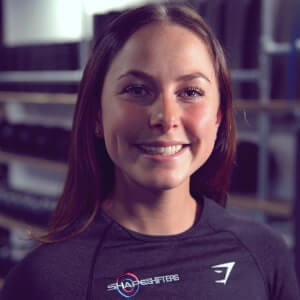
Georgina | Sports Therapist | BSc (HONS) MSST
© Shapeshifters | All Rights Reserved